
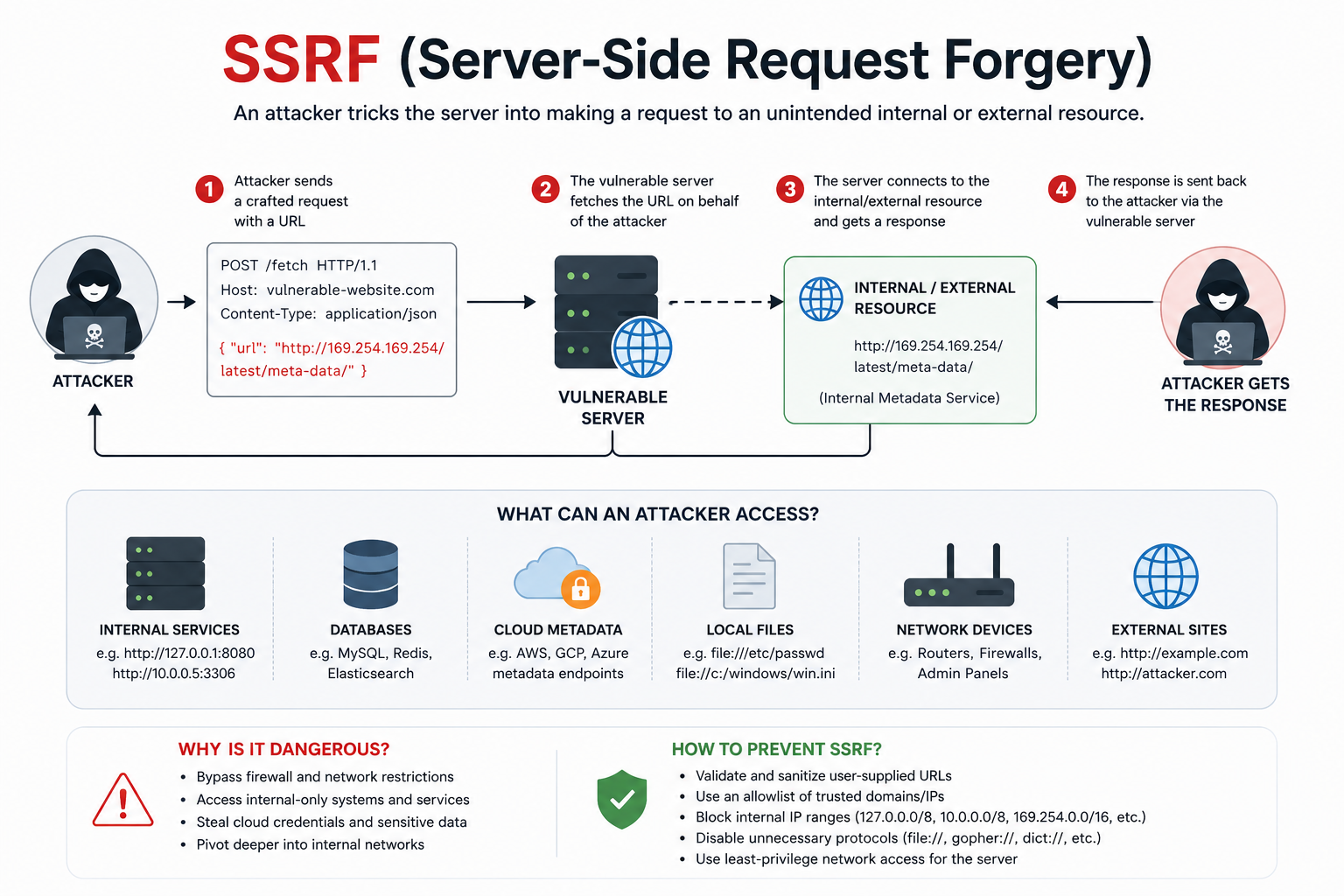
SSRF
# Index
# Description
# Understanding SSRF
# How SSRF Works
# Why SSRF is Dangerous?
# Preventing SSRF
# SSRF in OWASP
# Description:
Server-Side Request Forgery (SSRF) is a web security vulnerability that allows an attacker to trick a server into making requests to unintended internal or external resources. Instead of communicating directly with a target system, the attacker abuses a vulnerable application to send requests on their behalf. Because the request originates from the trusted server, the attacker may gain access to resources that would normally be inaccessible.
# Understanding SSRF
Modern applications often retrieve content from external sources.
Common examples include:
- URL preview generators
- Image fetchers
- PDF generators
- Webhooks
- Third-party API integrations
A typical workflow might allow a user to submit a URL, which the server then fetches.
For example: https://example.com/fetch?url=https://website.com/image.png
If the application does not properly validate the URL, an attacker may provide a malicious destination instead.
The server will then unknowingly perform the request.
# How SSRF Works
Consider the following process:
- The attacker identifies a feature that accepts a URL.
- The attacker submits a specially crafted URL.
- The vulnerable server fetches the resource.
- The response is returned to the attacker.
Since the request originates from the server, it may bypass network restrictions and access protected systems.
# Why SSRF is Dangerous?
SSRF can allow attackers to access resources that are normally hidden from the internet.
Potential targets include:
- Internal APIs
- Private databases
- Cloud metadata services
- Internal dashboards
- Network devices
- Administrative interfaces
In many environments, internal systems trust requests originating from other internal servers.
This makes SSRF particularly dangerous.
Cloud Infrastructure Risks
Cloud environments are especially vulnerable to SSRF attacks.
Many cloud providers expose metadata endpoints that contain sensitive information about running services.
Examples include:
- Instance configuration
- IAM credentials
- Access tokens
- Network information
If an attacker can access these endpoints through SSRF, they may gain access to cloud resources beyond the vulnerable application itself.
Real-World Example
Imagine a website that generates previews for URLs submitted by users.
A normal request might look like: https://news.example.com/article
An attacker instead submits: http://internal-admin-panel.local
The application fetches the page and returns the contents.
The attacker now gains visibility into an internal system that should never have been exposed externally.
Common SSRF Targets
Attackers often attempt to access:
- Internal web applications
- Cloud metadata services
- Database administration panels
- Monitoring dashboards
- Kubernetes services
- Internal APIs
- Network devices
These systems may contain sensitive information or provide further access into the organization's infrastructure.
# Preventing SSRF
Organizations can reduce SSRF risk by implementing several security controls.
Validate User-Supplied URLs
Only allow URLs that match expected formats and trusted destinations.
Reject unexpected protocols and malformed URLs.
Use Allowlists
Instead of allowing requests to any destination, maintain a list of approved domains and services.
This is generally more secure than relying on blocklists.
Restrict Internal Network Access
Servers should not have unrestricted access to internal systems unless absolutely necessary.
Network segmentation can significantly reduce SSRF impact.
Disable Unnecessary Protocols
Applications should disable support for protocols that are not required.
Examples include:
- file://
- ftp://
- gopher://
Reducing available protocols decreases the attack surface.
Implement Least Privilege
Applications should operate with the minimum permissions required.
Even if SSRF occurs, limited privileges help reduce potential damage.
# SSRF in OWASP
Server-Side Request Forgery was added as a dedicated category in the OWASP Top 10 because of its increasing prevalence in modern cloud-native applications.
As organizations adopt microservices, APIs, containers, and cloud platforms, SSRF has become a more significant security concern.
Article Metadata:
Published Date: 2026-06-15
Updated Date: 2026-06-15
About the Author: Team absequ is a group of engineers and researchers working on real-world systems, software development, and technology solutions.